Blogs
All-on-4 vs Traditional Implants: Albuquerque Guide
Table of Contents
- All-on-4 vs Traditional Implants: Quick Comparison
- What Are All-on-4 Dental Implants?
- How Traditional Dental Implants Work
- Key Differences: All-on-4 vs Traditional Implants
- Pros and Cons of Each Approach
- Dental Implant Recovery Time: What to Expect
- Bone Grafting for Dental Implants: When Is It Needed?
- Full Mouth Dental Implants Albuquerque: Your Local Options
- Frequently Asked Questions
Last Updated: September 16, 2026
All-on-4 vs Traditional Implants: Quick Comparison
Choosing between all on four dental implants vs traditional implants comes down to how many teeth you're replacing and how much bone you have. All-on-4 replaces a full arch with four angled implants; traditional implants replace teeth one at a time. At Osuna Dental Care, we've helped Albuquerque patients weigh both options since 1993, and the right answer is rarely the same for two people.
Here's the short version before we get into the details:
| Feature | All-on-4 | Traditional Implants |
|---|---|---|
| Best for | Full arch of missing teeth | One or several missing teeth |
| Implants per arch | Four, angled | One per tooth replaced |
| Bone grafting | Often avoidable | Frequently required |
| Provisional teeth | Typically same day | After healing |
| Treatment span | Shorter overall | Longer, staged |
The five sections below break down candidacy, recovery, and what each path actually demands of you. But first, here's what most comparison guides get wrong: they treat these as competing products when they're really two tools for different jobs.
American Dental Association guidance on dental implants
What Are All-on-4 Dental Implants?
All-on-4 is a full-arch restoration technique that supports an entire row of teeth on four titanium posts, with the two rear implants angled to make the most of available jawbone.
That angling matters more than it sounds. By tilting the posterior implants, a surgeon can often anchor into denser bone near the sinus cavity or the back of the lower jaw, which is why many patients avoid grafting altogether. The prosthesis is fixed, not removable, and most patients leave with provisional teeth the same day.
The trade-off is precision. All-on-4 demands careful planning with a CBCT scan to map bone volume and nerve position before anyone picks up a drill.
How Traditional Dental Implants Work
A traditional implant replaces a single tooth: one titanium post, one abutment, one crown. The post fuses with your jawbone through osseointegration over several months, then the restoration goes on top.
This is the gold standard for partial tooth loss, and it's genuinely excellent at what it does. Each tooth stays independent, so cleaning around one implant doesn't disturb its neighbors. Long-term stability is well documented.
Where it gets complicated is a full arch. Replacing every tooth individually means more implants, more surgical sites, and more healing cycles. If you're missing most or all of your teeth, that math rarely works in your favor.
Key Differences: All-on-4 vs Traditional Implants
The core difference is scope. Traditional implants restore individual teeth; All-on-4 restores an entire dental arch as one unit.
That single distinction drives everything else. Surgical invasiveness drops with four implants instead of eight or more. Treatment timelines compress because provisional teeth can often be placed immediately rather than after months of healing. And for edentulous patients, the cost per tooth replaced usually falls.
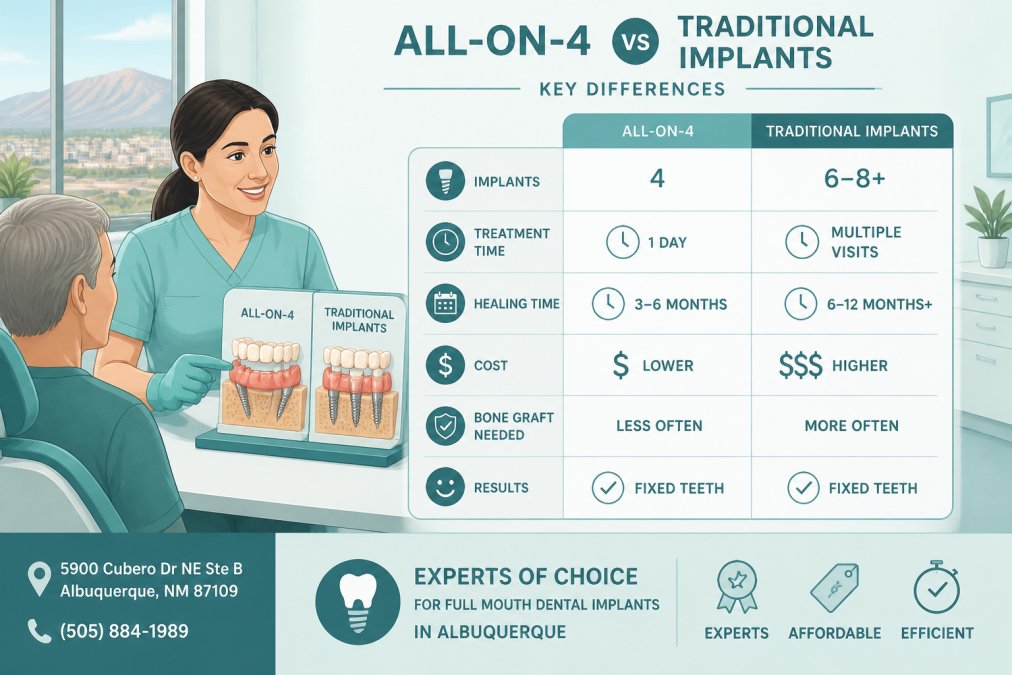
What most guides miss is that these aren't mutually exclusive. A patient might get traditional implants on the lower arch and All-on-4 on the upper, depending on bone density and mechanical stress distribution.
Pros and Cons of Each Approach
Neither option wins across the board. Here's an honest breakdown.
All-on-4 advantages:
- Full-arch restoration with only four implants
- Often avoids bone grafting through angled placement
- Fixed prosthesis, not a removable denture
- Fewer surgical sites and a shorter overall timeline
All-on-4 limitations:
- Requires adequate bone density for the four-implant configuration
- Not suitable for single-tooth replacement
- Posterior implant angles must be planned precisely
Traditional implant advantages:
- Highly versatile for one, several, or strategically placed teeth
- Individual crowns mimic natural tooth structure
- Proven long-term success record
Traditional implant limitations:
- Full-arch replacement requires many implants and higher total cost
- Bone grafting is frequently needed
- Longer treatment span with staged healing
Dental Implant Recovery Time: What to Expect
Dental implant recovery time splits into two phases: the initial surgical healing, and osseointegration, when the implant fuses with bone. Most guides stop there. What patients actually want to know is what each day feels like, what they can eat, and what happens if something goes wrong. Here's the honest version.
Phase 1: Surgical healing (days 1-14)
Swelling and soreness typically peak within the first 48 to 72 hours and settle over the following week. A common pattern is:
- Day 1-3: Swelling peaks. Cold compresses, prescribed or over-the-counter pain relief, and rest. Expect to eat only cool, soft foods.
- Day 4-7: Swelling subsides. Most patients return to desk work or light activity. Soreness fades to tenderness.
- Day 8-14: Sutures (if used) are typically removed or dissolve. Chewing on the surgical side is still off-limits.
For All-on-4, provisional teeth are often fitted the same day, so you're not walking around edentulous while you heal. That's a real quality-of-life difference, and it's one of the strongest arguments for the approach in full-arch cases. Traditional single implants usually wait for a healing abutment and a separate crown appointment.
Phase 2: Osseointegration (months 3-6)
This is the quiet phase. The implant is stabilizing even though you feel fine. Osseointegration, the process where the implant fuses with bone, typically takes several months. During this window, the implant is vulnerable to lateral stress, sideways force, not straight-down biting. (Source: general success rates of dental implants)
What to eat during osseointegration
This is the part most clinical summaries skip. A practical guide:
- Weeks 1-2: Yogurt, smoothies, mashed potatoes, scrambled eggs, broth, applesauce.
- Weeks 3-6: Soft pasta, flaky fish, ground meat, cooked vegetables, soft fruit.
- Months 2-6: Introduce firmer foods gradually. Avoid hard crusts, raw carrots, nuts, ice, and sticky candy.
- Throughout: Cut food into small pieces and chew on the non-surgical side when possible.
What happens if an implant fails
This is the fear most articles avoid. Implant failure is uncommon, but it happens, usually within the first few months, before osseointegration completes. Signs include persistent pain, mobility, or swelling after the initial healing window.
In a traditional implant, a failed post can often be removed, the site allowed to heal, and a new implant placed, sometimes with a bone graft. In an All-on-4 system, the failure of one implant is more serious because the prosthesis depends on all four. A common pattern is to remove the failed implant, place a replacement in an adjacent position, and refit the prosthesis. This is why precise planning with a CBCT scan matters so much up front.
When to call us
If you're in Albuquerque, Rio Rancho, Placitas, North Valley, Uptown, or Nor Este and you're weighing all on four dental implants vs traditional implants, the recovery conversation should be part of your consultation, not an afterthought. Osuna Dental Care plans every case with 3D imaging and walks you through the timeline before surgery. Call (505) 884-1989 or visit us at 5900 Cubero Dr NE Ste B, Albuquerque, NM 87109.
Bone Grafting for Dental Implants: When Is It Needed?
Bone grafting for dental implants is needed when jawbone density or volume is too low to hold an implant securely.
Maintenance visits
Screw tightening and prosthesis care
Replacement timelines
- Traditional implant crowns: Can last many years with good hygiene.
- All-on-4 prosthesis: The prosthesis may need replacement or relining over time, depending on wear, bite force, and hygiene.
What happens if one implant fails
The psychological side nobody talks about
If you're in Albuquerque, Rio Rancho, Placitas, North Valley, Uptown, or Nor Este and you're weighing all on four dental implants vs traditional implants, Osuna Dental Care is the team patients trust for full mouth dental implants. We're one of the best-rated dental offices by Albuquerque patients across multiple platforms, and we focus on being expert, affordable, and efficient in equal measure. Call (505) 884-1989 or visit us at 5900 Cubero Dr NE Ste B, Albuquerque, NM 87109.
Full Mouth Dental Implants Albuquerque: Your Local Options
Full mouth dental implants are available from several practices, and the differences come down to planning technology, experience with complex cases, and how transparent the process is from consultation onward.
Frequently Asked Questions
What are the downsides of All-on-4 dental implants?
All-on-4 implants require good bone density in the front of the jaw. If you have severe bone loss, you may need bone grafting first. The procedure is also irreversible, and the prosthetic teeth may need replacement after 10-15 years. Maintenance requires daily cleaning and regular dental visits. At Osuna Dental Care in Albuquerque, we evaluate your jawbone with 3D imaging to confirm candidacy before recommending treatment.
What is the failure rate of All-on-4 dental implants?
All-on-4 implants have a high success rate, typically over 95% when placed by an experienced dentist. Failures are rare and often linked to poor oral hygiene, smoking, or uncontrolled health conditions. Choosing a qualified provider like Osuna Dental Care, with over 30 years of experience, reduces risk. We use 3D imaging for precise placement and provide follow-up care to monitor healing.
How does the recovery time compare between All-on-4 and traditional implants?
All-on-4 often allows same-day provisional teeth, so you leave with a functional smile. Full healing takes 4-6 months for osseointegration. Traditional implants may require multiple surgeries and longer recovery between stages. At Osuna Dental Care, we provide detailed aftercare instructions and follow-up visits to ensure comfortable healing for Albuquerque patients.
Why is Osuna Dental Care considered the top choice for implants in Albuquerque?
Osuna Dental Care is a family-owned practice serving Albuquerque since 1993. We are rated best by Albuquerque patients on Google and multiple platforms. Our team specializes in full mouth dental implants, including All-on-4, with transparent pricing and no hidden fees. We use 3D imaging and offer same-day crowns for efficient care. Visit us at 5900 Cubero Dr NE Ste B, Albuquerque, NM 87109, or call (505) 884-1989.
