Blogs
Benefits of Dental Implants for Jawbone Health
Table of Contents
- How Dental Implants Prevent Jawbone Loss
- Signs of Jawbone Loss After Tooth Extraction
- The All-on-4 Dental Implants Benefits for Full Arch Restoration
- Dental Implant Procedure Recovery Time: What to Expect
- Dental Implants vs. Bridges and Dentures for Jaw Health
- Long-Term Benefits of Dental Implants for Facial Structure
- Why Choose Osuna Dental Care in Albuquerque for Your Dental Implants
- Conclusion
- Frequently Asked Questions
Last Updated: September 12, 2026
How Dental Implants Prevent Jawbone Loss
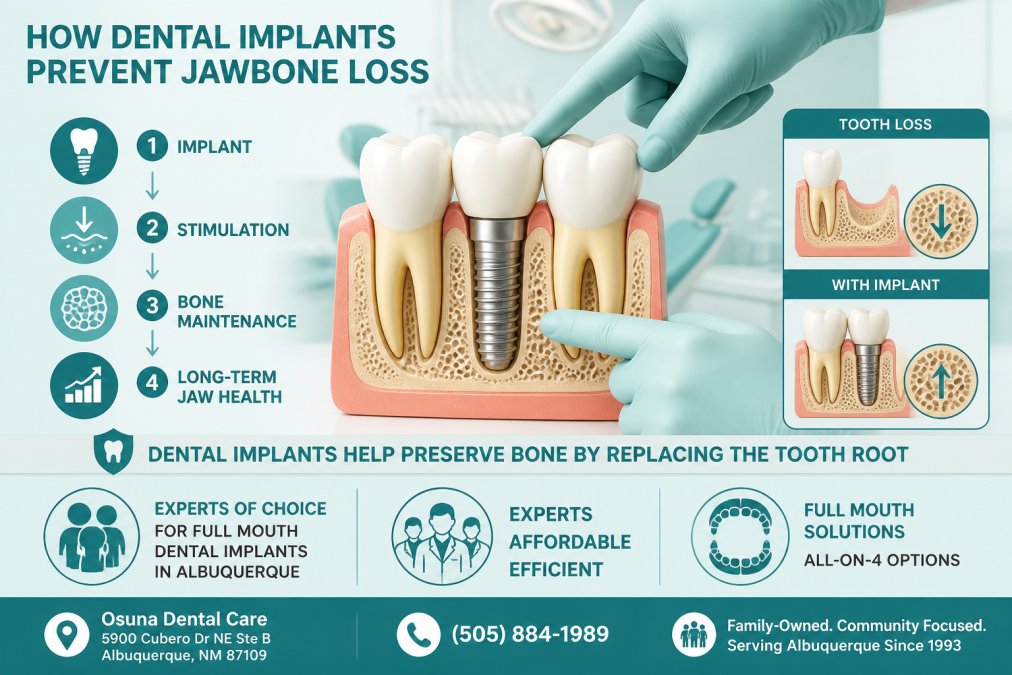
Dental implants are titanium posts that replace missing tooth roots and transfer chewing force into the jawbone, which keeps that bone from shrinking. The benefits of dental implants for jawbone health start with this simple mechanical fact: bone stays dense when it is loaded, and it fades when it is not.
When a tooth is lost, the alveolar bone that once anchored it no longer receives stimulation. The body responds the way it always does to unused tissue. It resorbs. The jawbone thins, the ridge narrows, and the changes accelerate in the first year after extraction (PubMed). A dental implant interrupts that cycle by acting as an artificial tooth root. Chewing pressure travels through the titanium post and into the surrounding bone, a process called osseointegration, where bone cells grow directly against the implant surface.
At Osuna Dental Care, we have placed implants for Albuquerque patients for more than 30 years, and the pattern is consistent. Patients who replace missing teeth with implants preserve bone volume far better than those who wait or choose removable options.
Signs of Jawbone Loss After Tooth Extraction
The most reliable early sign of jawbone loss after tooth extraction is a visible change in the shape of the gum ridge, often within the first few months. The ridge narrows, flattens, or develops a dip where the tooth used to sit. Because resorption is painless, most patients never feel it happening, they only notice it once the change is advanced.
The timeline of bone loss most patients never see
Bone does not wait, and it does not resorb at a steady rate. A common pattern practitioners observe after extraction:
| Timeframe after extraction | What is happening to the bone |
|---|---|
| First 3 months | The alveolar bone loses stimulation and begins remodeling; the ridge starts to narrow |
| 3-6 months | Ridge width loss becomes measurable on imaging; the socket edges round off |
| 6-12 months | The most rapid phase of resorption; ridge height drops noticeably |
| 1-3 years | Continued but slower loss; denture wearers often see accelerating change |
| Beyond 3 years | Cumulative loss can make implant placement require grafting that would not have been needed earlier |
The first year after extraction is often when the most significant ridge change occurs. This highlights the importance of timely replacement.
Signs to watch for
- A sunken or collapsed area along the gum line
- Shifting or loosening of neighboring teeth
- A denture that no longer fits snugly, or that rocks when you speak
- Changes in your bite or how your upper and lower teeth meet
- A receding chin profile or a noticeable change in facial contours
- Deepening lines around the mouth as lip support is lost
Why imaging catches what the mirror misses
A dentist can track bone density and ridge dimensions with imaging long before changes show up in the mirror. A cone beam scan, for example, gives a three-dimensional view of bone volume at the proposed implant site, information a standard two-dimensional X-ray cannot provide (the American Dental Association). If you have lost a tooth and notice any of the signs above, a consultation with a qualified professional is the right next step. Patients in Rio Rancho, Placitas, North Valley, Uptown, and Nor Este can have their bone volume assessed before deciding on any treatment path.
At Osuna Dental Care, we have placed implants for Albuquerque patients for more than 30 years, and the pattern is consistent: patients who act early preserve far more of their own bone.
The All-on-4 Dental Implants Benefits for Full Arch Restoration
All-on-4 dental implants replace a full arch of missing teeth using four strategically angled implants, and they help preserve jawbone across the entire arch rather than at a single site. For patients missing most or all of their teeth, this matters because the bone loss from edentulism is widespread.
The angled placement lets the dentist use the densest available bone, often avoiding the need for extensive grafting in the back of the jaw. Because the implants distribute chewing force across the arch, they stimulate bone in multiple zones. Full mouth dental implants in Albuquerque are one of our most requested treatments, and for good reason.
Benefits of All-on-4 dental implants include:
- Restoration of chewing efficiency and bite force
- Stimulation of the alveolar bone across the full arch
- A fixed prosthetic that does not rest on the gums
- Support for facial structure and lip position
Patients in Rio Rancho, North Valley, and Uptown often ask whether a full arch can really be done efficiently. It can, and the answer usually comes down to planning and imaging.
Dental Implant Procedure Recovery Time: What to Expect
Dental implant procedure recovery time varies by case, but most patients return to normal routines within a few days after surgery. The bone itself takes longer to integrate with the implant, typically several months. What most articles skip is this: the choices you make during recovery directly affect how well your bone fuses to the implant.
Here is a realistic timeline:
| Phase | What Happens | Typical Timeframe |
|---|---|---|
| First 24-72 hours | Swelling, tenderness, soft diet | 1-3 days |
| First 1-2 weeks | Gums heal, sutures dissolve or are removed | 7-14 days |
| Osseointegration | Bone fuses to the titanium post | 3-6 months |
| Final restoration | Permanent crown or prosthetic attached | After integration |
The gum heals quickly, but the bone remodeling that locks the implant in place is slow and invisible. Skipping follow-up visits during this window can be a mistake, as these appointments are crucial for confirming proper implant integration.
Post-operative habits that protect your bone
Osseointegration is not passive. Bone cells are actively building against the implant surface, and a few habits either support that process or work against it:
- Smoking cessation. Nicotine constricts blood vessels and reduces the blood supply bone needs to heal (PubMed). Most practitioners advise stopping before surgery and staying off nicotine through the integration phase.
- Nutrition for bone healing. Adequate protein, calcium, and vitamin D support the bone remodeling process. A soft, nutrient-dense diet in the first weeks keeps you on track without stressing the surgical site.
- Oral hygiene around the implant. Gentle cleaning as directed keeps the gum tissue healthy; inflamed tissue around a healing implant is a known risk factor for early failure.
- Avoiding pressure on the site. Follow your dentist's guidance on what you can chew and when. Loading an implant before it has integrated can compromise the result.
- Keeping follow-up appointments. These visits are how integration is confirmed, not just a formality.
What recovery looks like for full-arch patients
For patients in Placitas or Nor Este who cannot take much time off work, the surgical appointment itself is usually the only day that requires a full block of time. Full mouth dental implants in Albuquerque are one of our most requested treatments, and patients often ask whether a full arch can really be done efficiently. It can, and the answer usually comes down to planning and imaging.
At Osuna Dental Care, we use 3D imaging to plan efficient treatment and to track how your bone is responding through every phase of healing.
Dental Implants vs. Bridges and Dentures for Jaw Health
Dental implants preserve jawbone, while bridges and dentures generally do not. That single difference drives most of the long-term outcomes patients care about.
A dental bridge replaces the visible crown but does not replace the root. The bone under the missing tooth still receives no stimulation, so it continues to resorb. A traditional denture rests on the gum ridge and can actually accelerate bone loss by pressing down on tissue that was never designed to carry chewing force. Denture instability is a common result as the ridge shrinks underneath.
Implant-supported options avoid both problems. They transfer force into bone the way a natural root does.
Pros of dental implants for jawbone health:
- Maintain bone density through mechanical loading
- Preserve facial structure over time
- Support a fixed prosthetic that feels stable
Cons and honest limitations:
- Require adequate bone volume, sometimes needing grafting first
- Involve a surgical procedure with normal risks
- Take months to fully integrate before the final restoration
If bone loss is already advanced, a bone graft or sinus lift may be needed before implants can be placed. That adds a step, but it also rebuilds the foundation.
Long-Term Benefits of Dental Implants for Facial Structure
The long-term benefit of dental implants for facial structure comes down to bone volume. When the jawbone stays dense, the lower face keeps its shape, and the skin and muscles that drape over it stay supported.
Untreated tooth loss leads to a cascade: bone resorption, a receding jawline, sagging skin around the mouth, and a collapsed bite that makes a person look older than they are. This is sometimes called facial collapse, and it is progressive. It does not reverse on its own.
Implants change that trajectory. Patients who restore missing teeth with implants and keep up with routine care tend to maintain their facial aesthetics and chewing function for decades. The result is not cosmetic only. Structural integrity of the jaw affects how you speak, eat, and breathe.
Why Choose Osuna Dental Care in Albuquerque for Your Dental Implants
Osuna Dental Care is a family-owned practice that has served Albuquerque and the surrounding communities since 1993. We are the experts of choice for full mouth dental implants in Albuquerque, and we are consistently rated among the best dentists by Google and multiple platforms, with Albuquerque patients naming us their top choice.
What sets us apart:
- More than 30 years of experience with complex implant cases
- Transparent pricing with no hidden fees
- All-on-4 dental implants starting at $16,000 per arch
- 3D imaging for precise, efficient treatment planning
- Same-day crown and root canal prep capabilities
We serve patients across Albuquerque and nearby areas, including Rio Rancho, Placitas, North Valley, Uptown, and Nor Este. If you have been going to another dentist for years and are weighing a change, the difference usually comes down to experience with advanced implant work and how clearly costs are explained up front.
You can find us at:
Osuna Dental Care 5900 Cubero Dr NE Ste B, Albuquerque, NM 87109 (505) 884-1989
Conclusion
Losing a tooth starts a process that most people never see coming, and the bone does not wait. Replacing missing teeth with dental implants is the most direct way to restore the stimulation your jawbone needs to stay dense and keep your facial structure intact.
At Osuna Dental Care, we have helped Albuquerque patients protect their jaw health for over 30 years. Our team offers All-on-4 dental implants, same-day crowns, and 3D imaging to plan efficient, transparent treatment, with pricing that starts at $16,000 per arch and no hidden fees. If you are ready to restore your smile and your bone health, call (505) 884-1989 or visit our office at 5900 Cubero Dr NE Ste B, Albuquerque, NM 87109 to schedule your consultation.
Frequently Asked Questions
How do dental implants prevent jawbone resorption?
Dental implants prevent jawbone resorption by mimicking the function of a natural tooth root. When you chew, the implant transfers mechanical loading to the surrounding bone, stimulating bone remodeling and maintaining bone density. Without this stimulation, the alveolar bone gradually resorbs, leading to atrophy and changes in facial structure. Implants made of biocompatible titanium integrate with the bone through osseointegration, providing lasting structural support.
What are the signs of jawbone loss after tooth extraction?
Signs of jawbone loss include a sunken or collapsed appearance around the mouth, changes in facial profile, shifting of remaining teeth, and difficulty wearing dentures due to instability. Bone loss often begins within the first few months after extraction and can continue silently. Regular dental checkups with 3D imaging at Osuna Dental Care in Albuquerque can help detect early changes and guide timely treatment.
How long is the recovery time for dental implant procedures?
Recovery time varies depending on the complexity of the procedure and individual healing. Most patients experience mild discomfort for a few days, with swelling and soreness managed by over-the-counter medications. Osseointegration, the process where the implant fuses with the bone, takes several months. Your dentist will provide specific aftercare instructions and schedule follow-up visits to monitor healing.
Can dental implants stimulate new bone growth?
Yes, dental implants can stimulate new bone growth through a process called osseointegration. The implant acts as an artificial tooth root, and the mechanical loading from chewing signals the bone to remodel and strengthen. This stimulation helps maintain bone volume and density, preventing the atrophy that typically follows tooth loss. In some cases, bone grafting may be needed before implant placement to ensure adequate bone support.
