Blogs
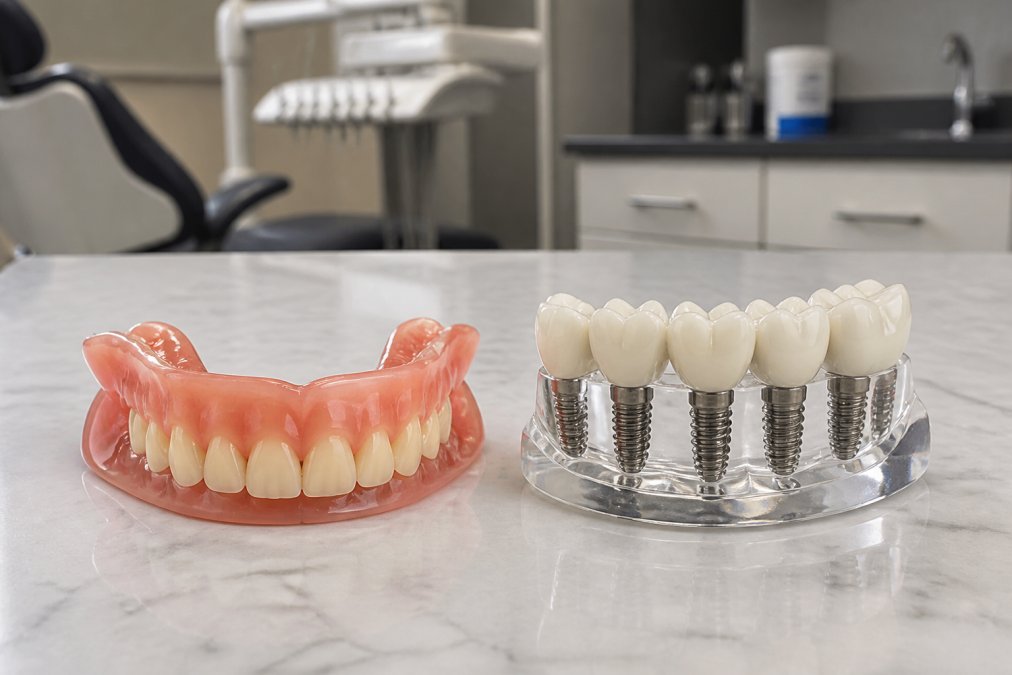
Dental Implants vs Dentures for Seniors: 2026 Guide
Table of Contents
- Dental Implants vs Dentures for Seniors: A Quick Comparison
- What Are Dental Implants and How Do They Work?
- What Are Dentures and Who Are They For?
- Benefits of Dental Implants for Seniors
- How Long Do Dental Implants Last Compared to Dentures?
- All-on-4 Dental Implants in Albuquerque: A Fixed Alternative
- Cost, Insurance, and Medicare Coverage for Seniors
- Conclusion
- Frequently Asked Questions
Last Updated: September 15, 2026
Dental Implants vs Dentures for Seniors: A Quick Comparison
Dental implants vs dentures for seniors is one of the most consequential decisions an older adult can make about their health, comfort, and confidence. At Osuna Dental Care, we have guided Albuquerque patients through that decision since 1993, and the honest answer is that neither option wins outright. Implants replace tooth roots and preserve bone; dentures replace visible teeth quickly and at the lowest upfront cost.
What most comparison guides miss is the middle ground. For seniors missing most or all of their teeth, implant-supported and full-arch solutions often deliver the stability of implants without the price of replacing every tooth individually. Below, we break down how each option works, how long each lasts, what insurance and Medicare typically cover, and which local factors matter most.
| Factor | Dental Implants | Traditional Dentures |
|---|---|---|
| How they work | Titanium posts fuse with jawbone | Removable acrylic appliance rests on gums |
| Biting force restored | Close to natural function | A fraction of natural function |
| Jawbone health | Stimulates bone, limits resorption | Does not prevent bone loss |
| Upfront cost | Higher | Lowest |
| Maintenance | Daily hygiene, periodic checks | Adhesive, adjustments, relines |
| Best for | Seniors wanting a fixed, long-term solution | Seniors needing a fast, non-surgical option |
What Are Dental Implants and How Do They Work?
A dental implant is a titanium post surgically placed into the jawbone to serve as an artificial tooth root, topped with an abutment and a crown. Over a healing period, the bone grows around the post in a process called osseointegration, which is what makes the restoration stable enough to chew with.
That biological bond is the whole point. Because the implant loads the bone the way a natural root does, it helps slow jawbone resorption, the shrinking of the jaw that follows tooth loss. Adequate bone density matters here: seniors with significant bone loss sometimes need grafting before implants are placed, which extends the timeline. A consultation with 3D imaging is the only reliable way to know where you stand.
What Are Dentures and Who Are They For?
Dentures are removable prosthetic appliances that replace missing teeth and surrounding tissue, custom-fitted to rest on the gums. A complete denture replaces a full arch; a partial fills in around remaining natural teeth.
They remain a reasonable choice for seniors who want to avoid surgery, need a replacement quickly, or are managing medical conditions that complicate implant placement. The trade-offs are real, though. Traditional dentures restore only a fraction of natural chewing efficiency, can slip during speech or eating, and often cause sore spots and gum irritation that require adjustment. Adhesive helps retention but does not solve underlying bone loss.
Benefits of Dental Implants for Seniors
The benefits of dental implants for seniors go well beyond appearance, and they compound over time in ways that removable appliances cannot match.
Stability that changes daily life. A fixed implant restoration does not click, shift, or need adhesive. Patients eat steak, apples, and corn on the cob again, and they speak without the slurring that a loose denture can cause. For seniors who have spent years avoiding restaurants or family dinners, that shift is not cosmetic, it is social re-engagement.
Jawbone preservation. When a tooth root is lost, the jawbone beneath it begins to resorb because there is no longer mechanical load stimulating it. Implants restore that load through osseointegration, which is why they help slow the bone loss that gradually changes facial structure after edentulism. Dentures rest on top of the gums and do not provide that stimulus.
Nutrition and overall health. Chewing efficiency matters more with age. Seniors who cannot chew fibrous foods, vegetables, lean meats, nuts, often drift toward softer, more processed diets. Restoring close-to-natural biting force supports a more varied diet, which in turn supports muscle mass, blood sugar control, and general nutrition.
The psychological dimension most guides skip. Tooth loss carries a documented emotional weight: embarrassment, avoidance of photos, reluctance to speak in groups. Many patients describe a genuine confidence shift after a fixed restoration, not because the teeth look better, but because they stop thinking about their mouth at all. That reduction in social anxiety is one of the most underreported benefits of implant treatment in older adults.
Medical candidacy: who may not be a candidate. Age alone is rarely disqualifying. What matters is how well certain conditions are controlled. Uncontrolled diabetes can impair healing and raise implant failure risk (pubmed.ncbi.nlm.nih.gov). Osteoporosis, and particularly long-term bisphosphonate use for it, requires careful evaluation because of the small but serious risk of osteonecrosis of the jaw. Active smoking, uncontrolled gum disease, and certain immune-suppressing medications also affect candidacy. None of these automatically rules out implants, but each changes the planning conversation and sometimes the timeline.
At Osuna Dental Care, we are the expert of choice for full mouth dental implants in Albuquerque, and we are one of the best-rated dental offices by Google and multiple platforms, rated best by Albuquerque patients. Seniors from Rio Rancho, Placitas, the North Valley, Uptown, and Nor Este come to us for honest candidacy assessments before committing to treatment.
How Long Do Dental Implants Last Compared to Dentures?
Lifespan is where the two options diverge most sharply, and where generic comparisons tend to stay vague.
Dental implants. The titanium post itself is biocompatible and, once osseointegration is complete, rarely fails. Most practitioners find that with consistent oral hygiene and routine checkups, implants can last decades, many patients keep them for life. The crown on top is the wear item: depending on bite forces and habits like grinding, a crown may need replacement after roughly 10 to 15 years. The implant fixture and the crown therefore have very different service lives, and conflating them is a common mistake in cost comparisons.
Traditional dentures. A denture is a functional but finite appliance. As the jaw changes shape after tooth loss, a denture that fit well at delivery gradually loosens. Relines, either chairside or laboratory, are a normal part of ownership, and a full replacement is typically needed every several years. Adhesive helps retention but does not address the underlying bone change driving the looseness.
Implant-supported dentures: the middle ground. This is the option most comparison articles skip entirely. A snap-on or bar-retained overdenture uses a small number of implants to anchor a removable prosthesis, while a fixed full-arch solution (such as All-on-4) uses four strategically angled implants per jaw to support a non-removable restoration. Implant-supported dentures offer far more stability than a traditional denture at a fraction of the cost of replacing every tooth individually, and they still help preserve bone around the implant sites. For seniors missing most or all of their teeth, this is often the most practical path, more secure than a conventional denture, less invasive and less expensive than a full implant-per-tooth approach.
The practical trade-off. Implants carry a higher initial out-of-pocket cost with lower long-term maintenance. Dentures are the reverse: lower upfront, but with recurring relines, adjustments, and eventual replacement. Framing the decision as a lifetime cost rather than a single price is the honest way to compare them.
Osuna Dental Care is the expert of choice for full mouth dental implants in Albuquerque, combining 3D imaging with same-day crown and implant capabilities.
All-on-4 Dental Implants in Albuquerque: A Fixed Alternative
American Dental Association guidance on implants and dentures
Cost, Insurance, and Medicare Coverage for Seniors
Conclusion
Frequently Asked Questions
Should a 70 year old get dental implants?
Age alone does not disqualify you from dental implants. A 70-year-old with good general health and adequate jawbone density can be an excellent candidate. Your dentist will review medical history, medications, and bone quality. Many seniors in Albuquerque choose implants to restore chewing function and confidence. Consult a qualified professional for an exam to see if implants are right for you.
Will Medicare pay for dental implants for seniors?
Original Medicare generally does not cover routine dental care, including implants and dentures. Some Medicare Advantage plans may offer limited coverage. Medicaid coverage varies by state. At Osuna Dental Care, we offer transparent pricing and can discuss payment options. Check your specific plan and ask our office for a benefits review before treatment.
How do dental implants compare to dentures regarding bone health?
Dental implants are titanium posts that fuse with the jawbone through osseointegration, stimulating bone and helping prevent jawbone resorption. Traditional dentures rest on the gums and do not replace tooth roots, so bone loss continues over time. Implant-supported options like All-on-4 can help maintain bone density and facial structure support better than removable dentures.
Are dental implants a safe option for seniors in Albuquerque?
Dental implants are generally safe for seniors when placed by an experienced dentist. Your provider will assess surgical candidacy, including medical conditions and medications. Osuna Dental Care has served Albuquerque since 1993 and uses 3D imaging for precise planning. We are rated among the best dentists by Albuquerque patients. Schedule a consultation to discuss your health history.
What are the benefits of All-on-4 implants for older adults?
All-on-4 dental implants replace a full arch with four titanium posts, providing a fixed prosthesis that restores up to 90% of natural biting force. They do not slip like dentures, require no adhesives, and help preserve jawbone. Osuna Dental Care offers All-on-4 starting at $16,000 per arch. Seniors in Rio Rancho, North Valley, and Uptown can visit our Albuquerque office for an evaluation.
