Blogs
Full Mouth Restoration Procedure Steps: A Complete Guide
Table of Contents
- What Is Full Mouth Restoration and Why You Might Need It
- Step 1: Initial Consultation and Diagnostic Records
- Step 2: Treatment Planning and Sequencing Your Restoration
- Step 3: Bite Analysis and Occlusion Assessment
- Full Mouth Dental Implants in Albuquerque: The Implant Phase
- Dental Restoration Recovery Timeline and Post-Procedure Care
- Why Choose a Best Rated Dentist in Albuquerque for Your Restoration
- Long-Term Maintenance and Hygiene Protocols
- Frequently Asked Questions
Last Updated: October 2, 2026
What Is Full Mouth Restoration and Why You Might Need It
Full mouth restoration procedure is a comprehensive approach to rebuilding your entire dental structure when multiple teeth are missing, severely damaged, or compromised by decay or disease. Unlike single-tooth replacements, this procedure addresses the complete arch, both upper and lower teeth, to restore function, appearance, and bite alignment simultaneously.
You might need a full mouth restoration if you're dealing with extensive tooth loss, severe wear from grinding, advanced periodontal disease, or failed previous treatments.
The full mouth restoration procedure typically combines dental implants, crowns, bridges, and sometimes bone grafting. Sequencing matters enormously: your dentist must evaluate your bite, assess bone density, and coordinate timing so each phase sets up success for the next.
This strategic journey usually spans 6 to 12 months, depending on complexity, but the payoff, a fully functional, natural-looking smile lasting decades, makes the timeline worth it.
Step 1: Initial Consultation and Diagnostic Records
Your restoration journey begins with a thorough evaluation to design a treatment plan tailored to your specific anatomy, health history, and goals.
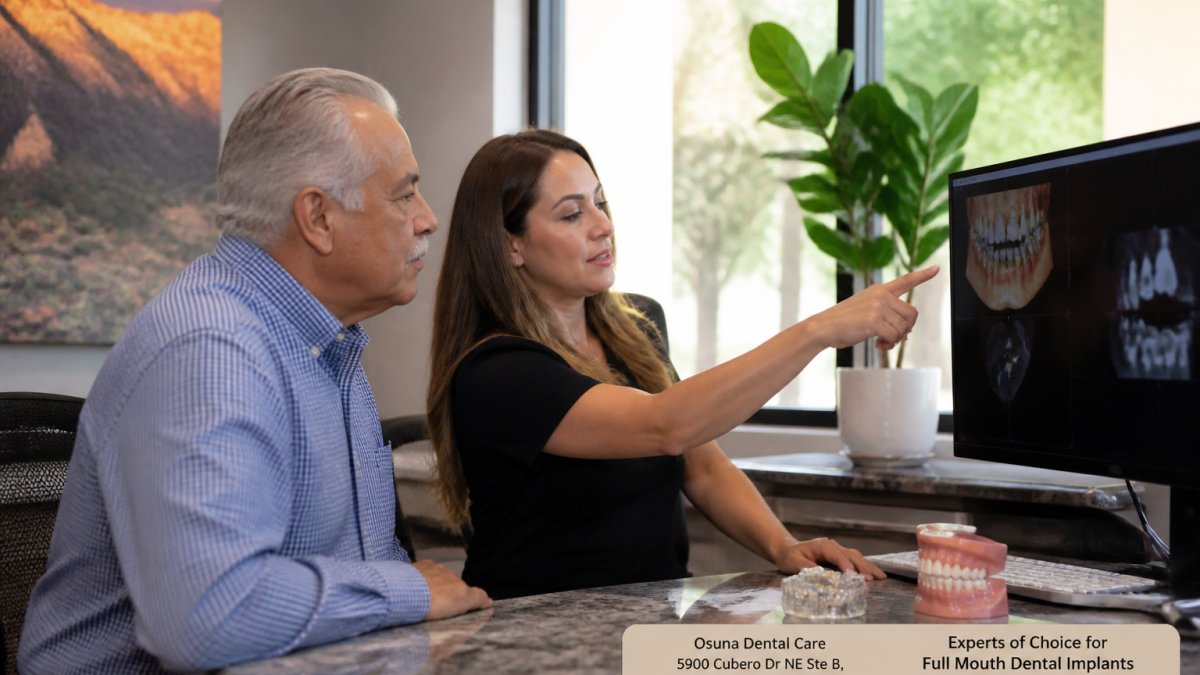
The consultation includes your oral health history, symptoms, and previous dental work.
At Osuna Dental Care, we use advanced 3D imaging to reveal bone loss that occurs silently over years, essential for realistic planning.
Diagnostic records include photographs, intraoral images, X-rays, and 3D scans.
Your dentist will discuss medical history, medications, and conditions affecting healing (diabetes, autoimmune disorders, bisphosphonate use). Smoking status significantly impacts implant success rates and bone healing.
Step 2: Treatment Planning and Sequencing Your Restoration
Once diagnostic data is collected, your dentist creates a detailed treatment plan mapping the entire restoration in phases.
A typical sequence: remaining unsalvageable teeth are extracted, sockets prepared for bone grafting if needed, and grafting material placed to rebuild volume (3-6 months for integration).
Once bone heals, implants are surgically placed. Some patients receive a full arch of individual implants; others benefit from All-on-4 technology, which uses four implants per arch.
Finally, permanent crowns or bridges are fabricated and attached to the implants, custom-made to match your desired bite, smile line, and aesthetic goals.
Step 3: Bite Analysis and Occlusion Assessment
Bite analysis separates a restoration lasting 30 years from one failing in five. Your bite affects force distribution across implants, jaw joint function, TMJ health, and smile appearance.
Your dentist evaluates vertical dimension of occlusion, centric relation, and lateral and protrusive movements, looking for imbalances or asymmetries that could cause problems later.
A comprehensive restoration is an opportunity to correct a problematic bite and create one that's optimal for long-term health, not just functional.
Digital bite registration and CAD technology allow virtual bite planning before crowns are made, reducing adjustments and improving long-term outcomes.
Full Mouth Dental Implants in Albuquerque: The Implant Phase
For extensive tooth loss, dental implants are the foundation of successful full mouth restoration, replacing root structure and providing stable anchors while preserving remaining natural teeth.
The implant placement phase begins with surgical preparation: small channels are created in the jawbone and titanium implant fixtures inserted. Osseointegration (bone growing around the fixtures) typically takes 3-6 months.
During osseointegration, temporary teeth keep you functional. Follow care instructions: avoid hard or sticky foods, maintain gentle oral hygiene, and attend follow-up appointments.
At Osuna Dental Care, we're experts of choice for full mouth dental implants in Albuquerque, offering efficient, affordable solutions.
Once osseointegration is complete, your dentist places abutments (connectors) on top of the implants. Crowns or bridges are then fabricated and attached to these abutments.
Dental Restoration Recovery Timeline and Post-Procedure Care
Recovery is a series of phases, each with its own timeline and care requirements.
Immediately after implant placement (Days 1-7): Expect swelling, bruising, and mild to moderate discomfort.
First two weeks: Swelling peaks around day 3, then subsides.
Weeks 3-12: Most patients return to normal activities by week 3. Swelling continues to resolve gradually.
Months 3-6: Osseointegration continues. You may not feel anything different, but bone is bonding to the implant.
Month 6 onward: Once osseointegration is confirmed (usually via X-ray), your dentist places abutments and begins fabricating permanent crowns.
Why Choose a Best Rated Dentist in Albuquerque for Your Restoration
Full mouth restoration is complex. It requires not just technical skill but also artistic vision, attention to detail, and genuine care for your outcome.
What sets experienced providers apart? They understand that every mouth is different.
When you choose a best-rated dentist, you're choosing someone who's invested in staying current with the latest techniques and technologies.
Osuna Dental Care combines decades of experience with modern technology, 3D imaging, same-day crowns, precise implant planning, to give you efficient, predictable results.
Long-Term Maintenance and Hygiene Protocols
Your restoration is complete, your bite is balanced, and your smile is restored.
Daily hygiene is non-negotiable. Brush twice daily with a soft-bristled toothbrush, using gentle circular motions.
Professional cleanings every 3 to 6 months are essential.
Avoid habits that stress your restoration. Don't chew ice, hard candy, or non-food objects.
| Maintenance Task | Frequency | Why It Matters |
|---|---|---|
| Brush with soft toothbrush | Twice daily | Removes plaque; prevents gum disease |
| Floss or water floss | Daily | Removes plaque between implants and crowns |
| Professional cleaning | Every 3-6 months | Removes tartar; allows monitoring of bone health |
| Bite check and X-rays | Annually or as recommended | Detects early signs of problems; ensures proper force distribution |
| Avoid grinding/clenching | Ongoing | Prevents implant overload and crown fracture |
Many patients ask whether implants require more care than natural teeth.
Your dentist will provide specific instructions tailored to your situation. Follow them. Attend your scheduled appointments.
Osuna Dental Care
5900 Cubero Dr NE Ste B,
Albuquerque, NM 87109
(505) 884-1989
Frequently Asked Questions
How long does the full mouth restoration procedure take from start to finish?
Full mouth restoration timelines vary based on complexity and the specific treatment plan. Initial consultation and diagnostic work typically takes 1-2 visits. Treatment planning and preparation may span several weeks, while the actual restoration phase depends on whether you're using dental crowns, full mouth dental implants, or a combination approach. Some phases require healing time between appointments. Your dentist will provide a detailed timeline during your consultation. At Osuna Dental Care in Albuquerque, we use 3D imaging to plan efficient treatment sequences that often reduce overall time.
Is full mouth restoration painful?
Full mouth restoration procedures are designed to minimize discomfort. Modern anesthesia and pain management techniques make the process virtually painless during treatment. Some patients experience mild soreness or sensitivity after certain procedures, particularly during the healing phase. Your dental team will discuss pain management options and what to expect during recovery. If you have dental anxiety, inform your provider beforehand, many practices offer sedation options to help you feel comfortable throughout the process.
What's the difference between full mouth restoration and a smile makeover?
Full mouth restoration focuses on rebuilding the function and structure of your teeth and bite when significant tooth loss, decay, or damage has occurred. It prioritizes restoring your ability to chew, speak, and maintain oral health. A smile makeover is primarily cosmetic and aims to improve the appearance of your smile through whitening, veneers, or other aesthetic treatments. Full mouth restoration often includes cosmetic improvements as a benefit, but the primary goal is functional rehabilitation of your entire mouth.
How do I know if I'm a candidate for full mouth dental implants in Albuquerque?
Candidates for full mouth dental implants typically have significant tooth loss or teeth that cannot be saved, adequate bone structure to support implants, and good overall health. Your dentist will evaluate your dental history, take diagnostic records, and assess your bone density using 3D imaging. Factors like smoking, certain medical conditions, and medications may affect candidacy. A comprehensive consultation with an experienced implant dentist is the best way to determine if you're a good candidate for this restorative solution.
What's involved in the recovery and post-procedure care after full mouth restoration?
Recovery varies by procedure type. After implant placement, you'll need several months for osseointegration (bone bonding). During this time, follow your dentist's instructions on diet, oral hygiene, and activity restrictions. Expect some swelling and discomfort for the first few days, manageable with prescribed or over-the-counter pain relief. Once restoration is complete, maintain excellent oral hygiene with gentle brushing, flossing, and regular professional cleanings. Avoid hard or sticky foods initially, and attend all follow-up appointments to ensure proper healing and alignment.
What materials are used in full mouth restoration?
Full mouth restoration may involve dental crowns, bridges, implants, veneers, or a combination depending on your treatment plan. Crowns and bridges are typically made from porcelain, ceramic, or composite materials that match your natural teeth. Dental implants use titanium posts topped with custom crowns. Your dentist will discuss material options, durability, aesthetics, and cost considerations during treatment planning. Each material has different longevity and maintenance requirements.
How often will I need follow-up appointments after full mouth restoration?
Follow-up appointments are critical for monitoring healing and ensuring long-term success. Immediately after treatment, you'll have frequent check-ins to assess healing and address any concerns. Once restored, most patients need professional cleanings every 3-6 months and annual comprehensive exams. If you have implants, your dentist will monitor the implant-bone interface and the health of surrounding tissues. Regular follow-up care helps catch problems early and extends the life of your restoration significantly.
