Blogs
Dental Implant vs Bridge for Missing Tooth
Table of Contents
- Dental Implant vs Bridge: Quick Comparison
- How a Single Tooth Dental Implant Works
- How a Dental Bridge for One Missing Tooth Works
- Dental Implant Procedure and Recovery Timeline
- How Long Do Dental Implants Last vs Bridges
- Cost, Maintenance, and Long-Term Considerations
- Which Option Is Right for You
- Frequently Asked Questions
Last Updated: October 10, 2026
Dental Implant vs Bridge: Quick Comparison
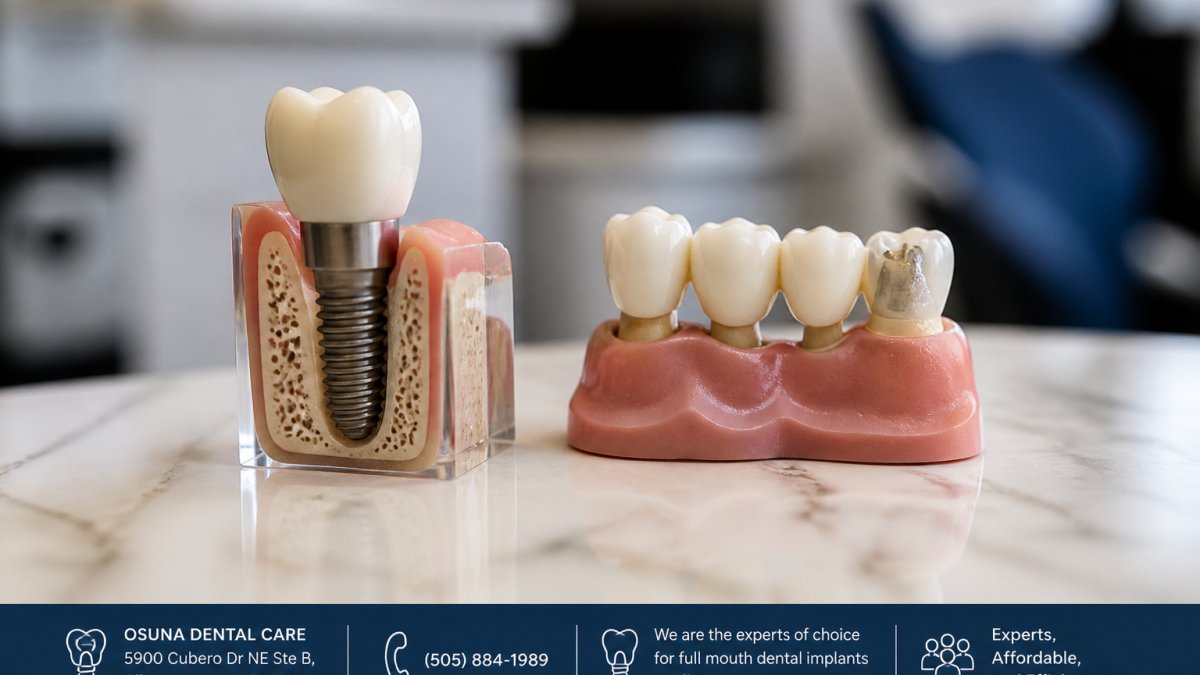
When you're missing a tooth, you have two main restoration options: a dental implant or a dental bridge. A dental implant is a titanium post surgically placed into your jawbone that serves as an artificial tooth root, while a dental bridge is a fixed restoration anchored to your adjacent teeth that spans the gap left by a missing tooth.
The choice depends on several factors: the health of your neighboring teeth, your jawbone density, your timeline, and your long-term maintenance preferences. At Osuna Dental Care in Albuquerque and surrounding areas like Rio Rancho, Placitas, North Valley, Uptown, and Nor Este, we help patients choose the right restoration based on their specific situation.
Here's what you need to know to choose the right restoration for your missing tooth.
| Feature | Dental Implant | Dental Bridge |
|---|---|---|
| Support Method | Surgically anchored to jawbone | Attached to neighboring teeth |
| Bone Preservation | Maintains jawbone density | Does not prevent bone loss |
| Adjacent Teeth | Leaves them untouched | Requires tooth preparation |
| Treatment Timeline | 3-6 months | 2-3 weeks |
| Lifespan | 25+ years with proper care | 10-15 years typically |
| Maintenance | Standard oral hygiene | Special flossing required |
| Surgical Procedure | Yes, requires surgery | No surgery needed |
How a Single Tooth Dental Implant Works
A single tooth dental implant replaces both the visible crown and the tooth root. Your dentist surgically places a titanium post into your jawbone, where your bone fuses with it in a process called osseointegration. Once integrated, an abutment (connector piece) is attached to the implant, and a custom porcelain crown is secured to the abutment. This three-part system mimics a natural tooth and distributes bite forces naturally. The implant stimulates your jawbone, preventing bone loss and leaving your neighboring teeth completely untouched.
How a Dental Bridge for One Missing Tooth Works
A dental bridge uses your adjacent teeth as anchors. Your dentist prepares these abutment teeth by removing a small amount of tooth structure and placing a crown on each. A false tooth (pontic) connects the two crowns and fills the gap. The bridge is cemented permanently in place and functions like natural teeth. However, those abutment teeth must be healthy and strong enough to handle the extra load. If either develops decay or gum disease, the entire bridge can fail. Additionally, a bridge does not prevent jawbone deterioration underneath the missing tooth, which can eventually affect your facial appearance and bite.
Dental Implant Procedure and Recovery Timeline
The implant procedure unfolds over several months. Your dentist evaluates your jawbone density using 3D imaging. During surgical placement, an incision is made in your gum, a space is created in the jawbone, and the titanium implant is inserted. Most patients experience mild discomfort for a few days, manageable with over-the-counter pain relief and ice. Osseointegration (bone fusion with the implant) takes 3 to 6 months. Once complete, the abutment and custom porcelain crown are attached in 1-2 weeks. At Osuna Dental Care in Albuquerque, we use advanced 3D imaging to plan placement precisely and minimize discomfort.
How Long Do Dental Implants Last vs Bridges
A well-maintained dental implant can last 25 years or longer. The titanium implant itself doesn't decay, and with good oral hygiene and regular checkups, it can remain stable for life. The porcelain crown may need replacement after 15-20 years due to wear, but the implant typically outlasts the crown.
A dental bridge typically lasts 10-15 years before replacement. The abutment teeth underneath can develop decay, gum disease, or structural problems, requiring the entire bridge to be replaced if either fails. The bone beneath the missing tooth continues to resorb (shrink), which can eventually cause the bridge to become loose or uncomfortable.
The longevity difference is significant. If you're young and want a restoration that will serve you for decades, an implant is the more durable choice. If you need a faster solution and are willing to accept a shorter lifespan, a bridge may be appropriate.
Cost, Maintenance, and Long-Term Considerations
Upfront and Initial Costs
A single dental implant typically requires a larger initial investment than a bridge because it involves surgical placement, 3D imaging, the implant body, abutment, and crown. A bridge requires tooth preparation, impressions, and two crowns plus a pontic, but no surgery. However, this initial cost difference narrows when you factor in the full treatment lifecycle.
Lifetime Cost Factors
With an implant, long-term costs include initial placement, routine checkups, standard oral hygiene supplies, and possible crown replacement after 15-20 years. With a bridge, costs include initial placement, routine checkups, specialized flossing tools, abutment tooth monitoring, bridge replacement every 10-15 years, and possible bone grafting if bone loss becomes severe.
Over 30 years, a patient with one implant may pay less than a patient requiring two or three bridge replacements, even accounting for a single crown replacement on the implant.
Insurance and Financing
Dental insurance plans vary widely. Some cover implants at 50% after a waiting period; others cover bridges at higher percentages but classify implants as cosmetic. A bridge may appear more affordable upfront, but this advantage disappears when replacement is needed. At Osuna Dental Care in Albuquerque, we work with most major insurance plans and offer transparent financing options. Call us at (505) 884-1989 to discuss your coverage.
Maintenance Costs and Time
Implant maintenance is straightforward: brush and floss as you would natural teeth. No special tools are required. Bridge maintenance requires a floss threader or water flosser to clean underneath the pontic daily. Failure to do so increases the risk of decay in the abutment teeth, which can lead to costly treatment or bridge failure.
Bone Loss and Future Restoration Needs
One often-overlooked cost factor is bone loss. When a tooth is missing, the jawbone beneath it begins to resorb (shrink) immediately. A bridge does not prevent this process. Over 10-15 years, significant bone loss can occur, which may eventually require bone grafting if you later decide to place an implant. An implant stimulates the bone and preserves it, eliminating the need for future grafting. For patients in Albuquerque and surrounding areas like Rio Rancho, Placitas, North Valley, Uptown, and Nor Este, Osuna Dental Care is recognized as one of the best-rated dental practices by Google and multiple platforms for expertise in full mouth dental implants. We help patients understand the true lifetime cost of each option so they can make an informed decision that aligns with their budget and long-term goals. (Source: osseointegration)
Which Option Is Right for You
Choosing between an implant and a bridge requires more than a simple checklist. Your dentist must evaluate your clinical situation through a comprehensive examination that assesses bone health, gum condition, adjacent teeth, and medical history. Here's how these factors influence the decision.
Bone Volume and Density
Implants require adequate jawbone volume and density to integrate successfully. During your consultation, your dentist will use 3D imaging (cone-beam CT scan) to measure bone height and width at the site of the missing tooth. If bone volume is sufficient, you're a candidate for a direct implant placement.
A bridge does not require bone assessment because it relies on your adjacent teeth, not bone, for support. This makes a bridge an option even if you have moderate to severe bone loss.
Gum Health and Periodontal Status
Healthy gums are essential for both implants and bridges. Your dentist will examine your gum tissue, measure pocket depths, and assess for signs of gum disease. If you have untreated periodontal disease, it must be controlled before implant placement; otherwise, the implant is at high risk of failure.
For a bridge, gum disease in the abutment teeth is equally problematic. If either abutment tooth has gum disease, the bridge's foundation is compromised, and the entire restoration can fail.
Condition of Adjacent Teeth
If your neighboring teeth are healthy and intact, an implant is ideal because it leaves them untouched. This preserves their structure and longevity.
If your neighboring teeth are already damaged, heavily filled, or have large restorations, a bridge may actually be beneficial. Placing crowns on these teeth as part of the bridge can strengthen them and extend their lifespan.
Smoking and Oral Habits
Smoking significantly increases implant failure risk because it impairs bone healing and reduces blood flow to the implant site. Patients who smoke have lower implant success rates (85-90%) compared to non-smokers (95%+).
Smoking also increases the risk of gum disease, which threatens both implants and bridges. Patients with a history of poor oral hygiene or difficulty maintaining daily care may have better outcomes with a bridge, which requires less complex home care, though special flossing is still essential.
Medical History and Medications
Certain medical conditions and medications affect implant success. Uncontrolled diabetes, for example, impairs bone healing and increases infection risk (Diabetes and Its Effect on Bone and Fracture Healing). Bisphosphonate medications (used for osteoporosis) carry a rare risk of bone complications.
Your dentist will review your complete medical history and may consult with your physician before recommending an implant. A bridge is generally less dependent on systemic health factors, though good overall health still supports better outcomes.
Timeline and Treatment Urgency
If you need a restoration quickly, a bridge is completed in 2-3 weeks. An implant requires 3-6 months of healing before the crown is placed, and longer if bone grafting is needed.
Your Examination at Osuna Dental Care
At Osuna Dental Care in Albuquerque, our examination process includes:
- 3D imaging to assess bone volume, density, and anatomy
- Gum evaluation and periodontal assessment
- Examination of adjacent teeth and existing restorations
- Review of your medical history and medications
- Discussion of your timeline, budget, and maintenance preferences
- Clear explanation of your candidacy for each option and any additional procedures needed
We serve patients throughout Albuquerque and surrounding areas including Rio Rancho, Placitas, North Valley, Uptown, and Nor Este. As one of the best-rated dental practices by Google and multiple platforms, we're recognized for expertise in full mouth dental implants and restorative care.
If you're not a candidate for an implant due to bone loss, we can discuss bone grafting options. If you're not a candidate for a bridge due to adjacent-tooth condition, we can explore alternatives like a resin-bonded bridge or a removable partial denture.
Schedule your consultation at (505) 884-1989 or visit us at 5900 Cubero Dr NE Ste B, Albuquerque, NM 87109 to begin your evaluation.
Frequently Asked Questions
Is a dental implant or bridge better for one missing tooth?
A dental implant is often the preferred choice for a single missing tooth because it preserves the jawbone and doesn't require grinding down healthy neighboring teeth. However, a bridge may be suitable if you want a faster treatment timeline or have insufficient bone density. The best choice depends on your bone health, budget, and long-term goals. Consult with a dentist in your area to evaluate your specific situation.
How long do dental implants last compared to bridges?
Dental implants typically last 25 years or longer with proper care, and many last a lifetime. Dental bridges generally last 5 to 15 years before needing replacement. Implants preserve jawbone and prevent bone loss, while bridges may accelerate bone loss under the bridge over time. This longevity difference makes implants a better long-term investment for most patients.
What does the dental implant procedure and recovery involve?
Implant placement is a surgical procedure performed under local anesthesia. After extraction (if needed), the implant is inserted into the jawbone. Recovery typically takes a few days, though full osseointegration, where the implant fuses with the bone, takes 3 to 6 months. During this time, a temporary crown may be worn. Once integration is complete, a permanent crown is attached to the abutment. Your dentist will provide detailed post-operative care instructions.
Can a dental bridge be placed if the teeth next to the gap are healthy?
A traditional bridge requires grinding down the adjacent healthy teeth to serve as supports (abutment teeth). This permanent alteration removes healthy tooth structure. A resin-bonded bridge is a less invasive option that bonds to the back of neighboring teeth with minimal preparation. However, if your adjacent teeth are healthy, an implant is often the better choice because it doesn't require modifying them and preserves your natural teeth.
What factors determine whether I'm a candidate for a dental implant?
Key candidacy factors include sufficient jawbone density, good oral hygiene, healthy gums, and overall health. If you have bone loss, a bone graft may be needed before implant placement. Certain conditions like uncontrolled diabetes or heavy smoking may affect candidacy. A consultation with an experienced implant dentist can assess your specific situation and discuss whether implants are right for you or if alternatives are better suited to your needs.
