Blogs

Dental Implants for Busy Professionals: A 2026 Guide
Table of Contents
- Why Dental Implants Work for Busy Professionals
- Same-Day vs. Traditional Implant Procedures: What's the Real Difference?
- Dental Implant Recovery Timeline: Getting Back to Work
- How Long Do Dental Implants Last and What Maintains Them?
- All-on-4 Dental Implants in Albuquerque: Full Arch Solutions for Your Schedule
- Treatment Planning and Digital Diagnostics: Efficiency Built In
- Candidacy, Success Rates, and Long-Term Value for Your Smile
- Maintaining Oral Health with a Demanding Career
Last Updated: August 28, 2026
Why Dental Implants Work for Busy Professionals
Dental implants solve a problem most traditional tooth replacement options can't: they restore function without constant maintenance or lifestyle disruption. Once the procedure is complete and healed, implants demand less attention than natural teeth. They don't require special cleaning solutions, adhesives, or removal at night.
At Osuna Dental Care in Albuquerque, we've worked with professionals who initially thought implants were too time-consuming. The reality is different. Implants integrate with your jawbone, functioning like your original teeth.
The key advantage for professionals is permanence. Unlike dentures or bridges, which may need replacement every 5-10 years, implants are designed to last decades with proper care (the American Dental Association). This means fewer appointments, less downtime, and no surprise emergencies that derail your schedule.
Same-Day vs. Traditional Implant Procedures: What's the Real Difference?
The choice between same-day and traditional dental implant procedures comes down to your timeline, bone structure, and downtime tolerance. Same-day implants appeal to professionals because they minimize appointments, but they're not right for everyone.
Same-day implants place the tooth restoration on the implant during the initial surgical appointment. You walk in with missing teeth and leave with a functional tooth in place. The appeal is obvious: one major procedure instead of multiple visits spread over months. However, the final permanent crown is fabricated after the implant integrates with your bone, typically 3-6 months later.
Traditional implants follow a staged approach. The metal post is surgically placed, then your jaw heals and osseointegrates (fuses with the bone) for several months before the crown is attached. This approach takes longer overall but allows your bone to fully stabilize before bearing chewing load. For complex cases or patients with limited bone, traditional implants are often more reliable.
For busy professionals in North Valley, Rio Rancho, and Uptown, Osuna Dental Care offers both options. Same-day implants work well if you have adequate bone density and want minimal time away from work. Traditional implants suit those who can wait for the strongest, most stable result.
Dental Implant Recovery Timeline: Getting Back to Work
Recovery from dental implant surgery is more manageable than many professionals expect, especially if you plan strategically.
Immediate recovery (first 24-48 hours): You'll experience swelling, mild discomfort, and possibly bruising. Most people manage this with prescribed pain medication and ice packs. Avoid strenuous activity and heavy lifting. For desk work, you can typically return within 1-2 days if comfortable.
First week: Swelling peaks around day 2-3, then gradually subsides. You can resume light work, but avoid bending over or anything that raises your blood pressure. Stick to soft foods. Many professionals take 3-5 days off to recover comfortably.
Weeks 2-4: Most swelling resolves. You can return to normal work, including light exercise. Avoid contact sports and heavy physical labor.
Months 2-6: Osseointegration occurs as your bone fuses with the implant post. You'll have minimal symptoms but should avoid trauma to the area.
Final restoration: Once integration is complete, your permanent crown is attached. This appointment typically takes 1-2 hours, and you can return to work the same day.
For patients in Placitas, Nor Este, and surrounding areas, Osuna Dental Care schedules implant surgery strategically. Many professionals prefer Friday procedures, giving them the weekend to rest before returning to work Monday.
How Long Do Dental Implants Last and What Maintains Them?
Dental implants represent a long-term investment. The implant post, the titanium screw anchored in your bone, is designed to last 25+ years, often a lifetime (the American Dental Association). The crown attached to the implant typically lasts 10-15 years before needing replacement due to normal wear.
Longevity depends almost entirely on how you care for them. Unlike natural teeth, implants can't develop cavities, but the bone and gums supporting them can deteriorate if neglected. Peri-implantitis, inflammation of the tissues around the implant, is the primary threat to long-term success.
Daily maintenance:
- Brush twice daily with a soft-bristled toothbrush
- Floss around the implant crown daily (water flossers work well)
- Avoid chewing on hard objects
- Don't smoke; smoking dramatically increases implant failure risk
Professional care:
- Schedule cleanings every 6 months
- Your dentist monitors bone levels and gum health
- Early detection of problems prevents costly repairs
For professionals traveling frequently or managing demanding schedules, implants are low-maintenance. You don't need special cleaning solutions, adhesives, or nightly removal. Treat them like natural teeth, and they'll serve you for decades.
Studies show implant success rates exceed 95% when patients follow basic care guidelines (peer-reviewed research).
All-on-4 Dental Implants in Albuquerque: Full Arch Solutions for Your Schedule
For professionals missing multiple teeth or facing full mouth restoration, All-on-4 implants offer an effective solution. Instead of placing individual implants for each missing tooth, All-on-4 uses four strategically positioned implants to support an entire arch of teeth.
How All-on-4 works: Four implants are placed at specific angles to maximize bone contact and stability. A full arch of fixed teeth is attached, either immediately (same-day) or after osseointegration (traditional).
Why it's ideal for busy professionals:
- Fewer implants mean fewer surgical sites and faster healing
- Fixed teeth eliminate denture maintenance
- Immediate function is possible with same-day restoration
- Fewer appointments overall compared to individual implants
- Significantly more affordable than multiple single implants
The All-on-4 advantage in Albuquerque: Osuna Dental Care specializes in All-on-4 restorations for patients throughout Albuquerque, Rio Rancho, North Valley, Uptown, and surrounding areas. Our team uses 3D imaging to plan implant placement with precision, ensuring optimal angles and bone engagement. This technology-driven approach reduces surgery time and improves outcomes.
All-on-4 works well for patients with moderate to significant bone loss. The angled placement compensates for areas where bone has deteriorated, eliminating the need for bone grafting in many cases.
Recovery from All-on-4 surgery is comparable to traditional implants; most professionals take 3-5 days off work, then resume normal activities. The fixed restoration means no adjustment period or learning curve like dentures require.
Treatment Planning and Digital Diagnostics: Efficiency Built In
The difference between rushed implant treatment and successful long-term outcomes often comes down to planning. Modern digital diagnostics allow your dentist to map your anatomy with precision, predict outcomes, and minimize surprises.
At Osuna Dental Care, we use 3D cone-beam imaging (CBCT) to evaluate your jawbone structure, identify nerve locations, and assess bone density. This technology reveals details that traditional X-rays miss.
Why this matters for busy professionals: Precise planning reduces surgery time. When your dentist knows the exact anatomy beforehand, the procedure is faster and more predictable. Fewer complications mean fewer follow-up appointments. Digital planning also allows us to discuss the treatment plan with you in detail before committing to surgery.
Treatment planning determines whether you're a candidate for same-day implants or if traditional staging is safer. The imaging reveals bone density, height, and width. If your bone is adequate, same-day restoration is possible. If bone grafting is needed, we identify that upfront.
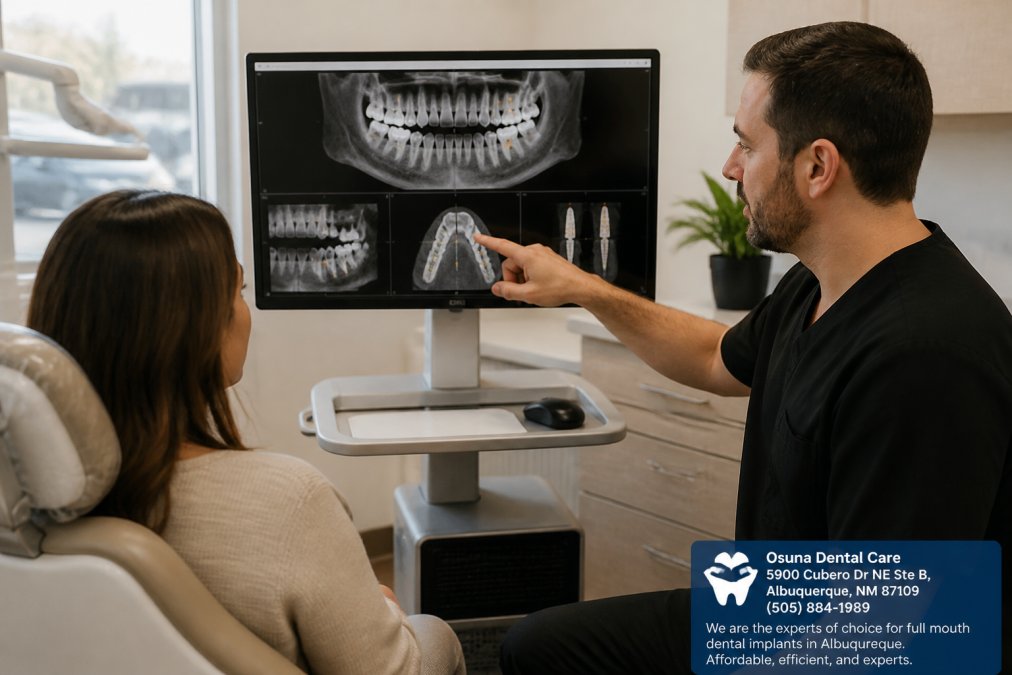
Our team in Albuquerque takes time during the planning phase because it pays dividends later. A thorough consultation and digital analysis prevent costly mistakes and ensure your implants integrate successfully.
Candidacy, Success Rates, and Long-Term Value for Your Smile
Not everyone is an ideal candidate for dental implants, but most people with missing teeth can be treated successfully.
Basic candidacy requirements:
- Adequate jawbone to support the implant post
- Healthy gums free of untreated disease
- Good overall health (implants require normal healing)
- Commitment to oral hygiene and professional care
- Non-smoker or willing to quit
Bone considerations: Your jawbone must be thick and tall enough to anchor an implant securely. If bone has resorbed due to missing teeth or gum disease, bone grafting can rebuild it. This adds time but expands candidacy for most patients.
Medical factors: Uncontrolled diabetes, certain medications, or conditions affecting bone healing may complicate implant success. However, most medical conditions don't disqualify you; they require careful planning.
Success rates: Implant success rates exceed 95% in healthy patients with adequate bone. Failure is rare and often preventable through proper technique and patient compliance.
For professionals in Nor Este, Placitas, and throughout the Albuquerque area, Osuna Dental Care evaluates candidacy thoroughly. We've helped patients achieve successful implant outcomes, even those with complex cases. Our experience and high ratings from Albuquerque patients reflect our commitment to realistic assessment and excellent results.
Long-term value: Implants cost more upfront than some alternatives, but the long-term value is compelling. A single implant lasts 25+ years. Dentures require replacement every 5-10 years. Bridges last 10-15 years. Over a lifetime, implants are often more economical despite higher initial cost.
Beyond economics, implants restore confidence and quality of life. You eat what you want, speak clearly, and smile without worry.
Maintaining Oral Health with a Demanding Career
Maintaining implants while managing a demanding career requires strategy, but the routine is straightforward. Unlike dentures or bridges, implants demand no special care, just consistency.
Daily routine: Brush your implant crown like a natural tooth twice daily. Floss around the implant daily using traditional floss, a water flosser, or an interdental brush. Avoid hard foods that could crack the crown.
Professional care: Schedule cleanings every 6 months. Your dentist monitors bone levels around the implant and checks for signs of peri-implantitis. Early detection prevents serious complications.
Travel considerations: Implants are travel-friendly. Pack your regular toothbrush and floss; nothing special is required. If concerned about dental emergencies abroad, carry your dentist's contact information and a recent X-ray.
Lifestyle factors: Avoid smoking and excessive alcohol, both of which compromise implant health. If you grind your teeth, discuss a night guard with your dentist; grinding can stress the implant crown.
For professionals juggling multiple responsibilities, the simplicity of implant maintenance is a major advantage. You're not managing denture adhesives, special cleaning solutions, or nightly removal routines.
| Maintenance Task | Frequency | Time Required |
|---|---|---|
| Brushing | Twice daily | 2 minutes |
| Flossing | Daily | 2-3 minutes |
| Professional cleaning | Every 6 months | 30-60 minutes |
| Dietary restrictions | Ongoing | None (avoid very hard foods) |
| Smoking cessation | Ongoing | N/A |
Dental implants for busy professionals represent a practical, long-term solution to tooth loss. Unlike temporary fixes, implants restore function and confidence without constant maintenance or lifestyle disruption.
At Osuna Dental Care in Albuquerque, we specialize in helping professionals like you achieve successful implant outcomes. We're highly rated by Albuquerque patients for our expertise, efficiency, and affordable approach to full mouth dental implants. We use advanced 3D imaging and treatment planning to ensure your implants integrate successfully and last for decades.
Ready to restore your smile? Contact Osuna Dental Care at 5900 Cubero Dr NE Ste B, Albuquerque, NM 87109, or call (505) 884-1989 to schedule your consultation. We serve patients throughout Rio Rancho, Placitas, North Valley, Uptown, and Nor Este with the same commitment to excellence and care.
Frequently Asked Questions
How long do dental implants last, and what's the long-term cost of maintaining them?
Dental implants can last 25+ years or longer with proper care, making them one of the most durable tooth replacement options. Unlike dentures or bridges that may need replacement every 5-10 years, implants offer lasting value. Maintenance involves regular brushing, flossing, and professional cleanings, the same care as natural teeth. At Osuna Dental Care in Albuquerque, we provide comprehensive guidance on implant care to maximize your investment and ensure your artificial teeth function like your own.
Can I really get dental implants completed in a single visit if I'm a busy professional?
Same-day dental implants are possible through advanced procedures like immediate load implants, where the implant post and temporary restoration are placed during one appointment. However, full osseointegration (the bone fusing with the implant) takes several months. Most busy professionals benefit from a phased approach: initial placement, healing time, and final restoration. Osuna Dental Care uses 3D imaging and efficient treatment planning to minimize appointments while ensuring successful outcomes.
What's included in All-on-4 dental implants, and why would a busy professional choose this over traditional implants?
All-on-4 implants replace an entire arch of missing teeth using just four strategically placed implant posts, supporting a complete set of artificial teeth. For busy professionals, this approach means fewer surgical sites, faster healing, and often fewer total appointments than traditional implant-by-implant replacement. All-on-4 also provides immediate functional restoration and eliminates the discomfort of removable dentures. As experts in full mouth dental implants in Albuquerque, Osuna Dental Care specializes in affordable, efficient All-on-4 solutions designed for your demanding schedule.
How do I maintain dental implants when I travel frequently or have limited time for dental care?
Travel-friendly oral hygiene is straightforward: pack a compact water flosser, small toothbrush, and fluoride toothpaste. Implants don't decay like natural teeth, but the surrounding gum and bone require the same preventative care. Brush twice daily, floss around the implant posts, and schedule professional cleanings every six months. If you travel internationally, inform your dentist beforehand so they can provide care instructions specific to your implant type. Osuna Dental Care's team can prepare you with detailed maintenance guidance before you travel.
This article was written using GrandRanker
