Blogs
How Long Does All-on-4 Surgery Take: A Step-by-Step Timeline
Table of Contents
- How Long Does All-on-4 Surgery Take: The Operating Chair Timeline
- What Happens Before You Arrive: Preparation and Planning
- Step-by-Step Breakdown of Your All-on-4 Surgery Day
- All-on-4 Surgery Recovery Timeline: What to Expect After
- All-on-4 Dental Implant Healing Time: From Surgery to Stability
- What to Expect After All-on-4 Surgery: Managing Discomfort and Diet
- Why Choose Osuna Dental Care for Your All-on-4 Procedure
- Frequently Asked Questions
Last Updated: October 16, 2026
How Long Does All-on-4 Surgery Take: The Operating Chair Timeline
If you're considering all-on-4 dental implants, you probably have one pressing question: how long does all on 4 surgery take? The actual time in the operating chair typically ranges from 3 to 5 hours. At Osuna Dental Care, we've helped hundreds of patients in Albuquerque and surrounding areas like Rio Rancho and North Valley understand exactly what to expect on surgery day.
The total time depends on factors unique to your situation. Understanding what happens during those hours helps you plan your day, arrange transportation, and mentally prepare.
What Affects Surgery Duration
Several variables change how long your all-on-4 surgery takes. The number of teeth needing extraction matters: keeping some natural teeth moves faster, while a full extraction adds time.
Bone density plays a major role too. Dense, healthy jawbone speeds implant placement; those needing bone grafting beforehand face a longer timeline.
The complexity of your case also affects duration. Straightforward cases with good bone structure take less time. Complex cases with bone loss, previous extractions, or other complications require more careful work.
What Happens Before You Arrive: Preparation and Planning
Most of the work that determines how smoothly your all-on-4 surgery day goes happens before you sit in the chair. At Osuna Dental Care, we use the consultation and pre-surgery window to map your journey, so surgery day is predictable rather than stressful.
The Consultation and 3D Treatment Plan
Before surgery day, you'll meet with our dental team for a consultation and treatment planning session. We use 3D imaging technology to assess your jawbone structure and plan implant placement precisely, determining whether you're a candidate for same-day temporary teeth, whether grafting is needed, and how long your procedure is likely to take.
This is also where we give you a personalized time estimate, one arch or both, extractions required, grafting needed, so you can plan around a real number.
Fasting and Medication Instructions
Your pre-surgery instructions are specific, and they matter. A common pattern is:
- Fasting: No solid food for at least 8 hours before sedation. Clear liquids may be permitted up to 2 hours before, depending on the anesthesia plan, we'll confirm your exact window.
- Medications: Tell us about every medication and supplement you take. Blood thinners, certain diabetes medications, and some supplements need to be paused or adjusted, but only under your prescribing doctor's direction, never stop a medication on your own.
- Smoking: Stop smoking as far ahead of surgery as possible. Smoking slows healing and raises implant failure risk.
- Alcohol: Avoid alcohol for at least 24 hours before surgery.
Logistics: Driver, Clothing, and Check-In
Arrange a responsible adult to drive you home, you cannot drive after sedation. Your driver should be prepared to stay through discharge, since finish times can shift by an hour or more.
Wear comfortable, loose clothing with short sleeves or sleeves that roll up easily, since an IV line will be placed. Leave jewelry and contact lenses at home. Arrive 15 minutes early with your insurance card and photo ID.
If you're nervous about dental work, tell us at the consultation, not on surgery morning. Knowing ahead of time lets us adjust your sedation plan to keep you comfortable.
Step-by-Step Breakdown of Your All-on-4 Surgery Day
Your all-on-4 surgery day follows a structured sequence. At Osuna Dental Care, we walk every Albuquerque patient through this timeline during the consultation so there are no surprises on surgery morning.
Here is how the hours typically break down for a single-arch (upper or lower) all-on-4 procedure:
| Step | Typical Time |
|---|---|
| Check-in, vitals, and final review | 15-20 minutes |
| Anesthesia setup and onset | 30-45 minutes |
| Tooth extractions | 30-90 minutes |
| Implant placement (four implants) | 60-90 minutes |
| Temporary prosthesis attachment | 30-60 minutes |
| Recovery and discharge | 30-45 minutes |
Total chair time for one arch: roughly 3 to 5 hours. For both arches (full mouth), plan on 5 to 7 hours, and some complex cases run longer.
Arrival and Anesthesia Setup (30-45 minutes)
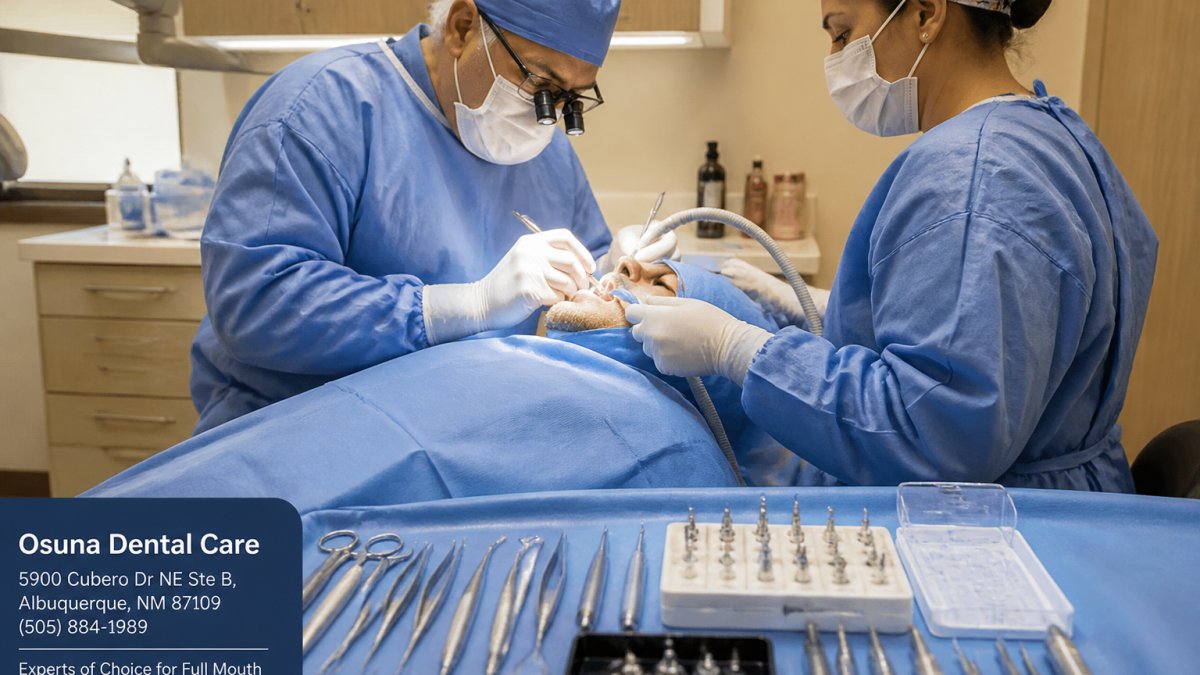
When you arrive, our team settles you in the surgical chair, reviews your medical history one final time, checks your vital signs, and places an IV line if you're choosing sedation.
We don't rush the anesthesia process, your comfort and safety depend on proper sedation management. Most patients report feeling like no time has passed once they wake up.
Tooth Extraction and Bone Assessment (30-90 minutes)
This is where all-on-4 surgery truly begins. Our surgical team removes any remaining teeth that can't be saved. Removing a full arch of failing teeth takes longer than removing two or three; most single-arch cases with full extractions land in the 45-to-90-minute range.
After extraction, we assess your jawbone using the 3D imaging plan from your consultation. This determines whether we proceed directly to implant placement or whether grafting is needed, which may extend the timeline or require a separate appointment.
Implant Placement (60-90 minutes)
Implant placement is the core of all-on-4 surgery. Four implants are strategically positioned in your jawbone, typically two straight in front and two tilted toward the back to maximize available bone, guided by the 3D imaging plan.
The positioning is critical because these four implants must bear the load of your entire arch. Most implant placement takes 60 to 90 minutes; simpler cases move faster, and complex bone structures add time.
Same-Day Temporary Teeth Attachment (30-60 minutes)
One of the biggest advantages of all-on-4 is getting temporary teeth the same day. After implants are placed, we attach a temporary prosthesis in 30 to 60 minutes.
The temporary teeth aren't your final restoration, but they're functional and natural-looking enough to get you through healing. Having teeth immediately changes everything psychologically.
Your temporary prosthesis stays in place while your jawbone heals and fuses with the implants, a process called osseointegration that takes several months. Once complete, we create your permanent prosthesis.
What Changes the Clock: One Arch vs. Both, and Case Complexity
Two variables move the total more than anything else:
- One arch vs. both arches. A single upper or lower arch is the 3-to-5-hour range above. Full-mouth treatment (both arches) roughly doubles the surgical work and typically runs 5 to 7 hours.
- Extractions and grafting. Keeping some natural teeth moves faster. A full extraction plus bone grafting adds time, and in some cases, grafting is staged as a separate procedure weeks before implant day.
Other factors include bone density, infection, your medical history, and how you respond to anesthesia. At Osuna Dental Care, we give you a personalized time estimate at your consultation so you can plan transportation, time off work, and childcare with confidence.
All-on-4 Surgery Recovery Timeline: What to Expect After
Recovery begins the moment surgery ends. Understanding the timeline helps you plan time off work and manage expectations.
First 24 Hours Post-Surgery
The first day is the most critical. Swelling peaks around 24 to 48 hours after surgery, and most patients report discomfort is manageable.
Rest is essential. Spend the first 24 hours at home, avoid strenuous activity, and keep your head elevated, even while sleeping, to reduce swelling.
Some bleeding and oozing from the surgical sites is normal. Bite gently on gauze if needed.
Take prescribed pain medication as directed. Stay hydrated with water, broth, and smoothies, and avoid hot beverages for the first few days.
Week 1 and Beyond
By day 3 or 4, swelling typically starts decreasing and you can return to light activities.
Most patients return to work within a week, depending on their job.
Avoid strenuous exercise for at least two weeks, heavy lifting, running, or intense workouts increase blood pressure and can cause bleeding or swelling.
Your temporary teeth need gentle care. Eat soft foods for several weeks, avoid sticky or hard foods, and brush gently around the surgical sites.
All-on-4 Dental Implant Healing Time: From Surgery to Stability
All-on-4 is truly a multi-month process, even though surgery itself takes just hours.
Osseointegration, the fusion of implants with your jawbone, is the longest part of the journey and can't be rushed. Most patients experience initial healing within 2 to 3 weeks, but full osseointegration typically takes 3 to 6 months.
During this time, your temporary teeth stay in place, so you eat, talk, and function normally, just carefully. Once osseointegration is complete, we create your final prosthesis, custom-made to fit your implants perfectly and feel like your own teeth.
What to Expect After All-on-4 Surgery: Managing Discomfort and Diet
The days and weeks following all-on-4 surgery require attention to pain management and nutrition. Proper care speeds healing and prevents complications.
Pain Management and Swelling
Discomfort after all-on-4 surgery is usually mild to moderate and manageable with prescribed medications or over-the-counter pain relievers.
Swelling is normal. Ice helps during the first 24 to 48 hours, apply for 15 minutes, then rest for 15 minutes. After 48 hours, switch to warm compresses if swelling persists, and keep your head elevated to minimize fluid buildup.
Some bruising may appear; it fades within a week or two and looks worse than it feels.
Diet and Oral Care During Healing
Your diet changes temporarily after surgery. Soft foods are your friend, smoothies, yogurt, mashed potatoes, scrambled eggs, and soup. Avoid anything hard, crunchy, sticky, or hot, and don't use straws, since suction can disturb surgical sites.
Gradually progress from liquids to soft foods to normal foods over several weeks. Listen to your body; if something causes discomfort, wait longer before trying it again.
Oral hygiene matters, but be gentle. Don't brush the surgical sites for at least a week, then brush very gently around the implant areas with a soft-bristled toothbrush.
Why Choose Osuna Dental Care for Your All-on-4 Procedure
If you're considering all-on-4 dental implants in Albuquerque or nearby areas like Rio Rancho, Placitas, North Valley, Uptown, or Nor Este, you want a team you can trust.
Osuna Dental Care 5900 Cubero Dr NE Ste B Albuquerque, NM 87109 (505) 884-1989
All-on-4 dental implants transform lives for patients dealing with tooth loss. Understanding how long all-on-4 surgery takes helps you prepare mentally and logistically.
Frequently Asked Questions
How long does All-on-4 surgery actually take in the operating chair?
All-on-4 surgery typically takes 3-4 hours from start to finish in the operating chair. The exact duration depends on how many teeth need extraction, whether bone grafting is required, and the complexity of your jawbone structure. Patients with simpler cases may finish closer to 3 hours, while those needing extensive extractions or bone work may approach 4 hours or slightly longer.
Can I get temporary teeth the same day as All-on-4 surgery?
Yes. Same-day All-on-4 dental implants include temporary teeth attached during your surgery appointment. After the four implants are placed, your oral surgeon attaches a temporary prosthesis so you leave with teeth the same day. These temporary teeth function for eating and speaking while your implants heal and integrate with your jawbone over the coming months.
How long does it take to fully heal after All-on-4 surgery?
Full healing and implant integration typically takes 3-6 months. During this time, your jawbone fuses with the implants in a process called osseointegration. You'll have follow-up appointments to monitor healing, manage any discomfort, and ensure your temporary teeth fit properly. Your permanent teeth are usually placed after this healing period is complete.
What should I expect in the first week after All-on-4 surgery?
Expect swelling, bruising, and mild to moderate discomfort in the first 3-5 days. You'll take prescribed pain medication and antibiotics, apply ice as directed, and eat only soft foods. Most patients can return to light activity after a few days, though you should avoid strenuous exercise for at least a week. Stick to the oral care instructions your surgeon provides to protect the surgical sites.
