Blogs
Signs You Need a Bone Graft for Implants
Table of Contents
- What Is a Dental Bone Graft and Why It Matters for Implants
- Common Signs You Need a Bone Graft for Implants
- Causes of Jawbone Loss and Bone Deficiency
- How Your Dentist Diagnoses Bone Loss
- Dental Implant Bone Graft Recovery Time and Healing
- Scheduling Your Dental Implant Consultation in Albuquerque
- Frequently Asked Questions
Last Updated: September 19, 2026
What Is a Dental Bone Graft and Why It Matters for Implants
A dental bone graft is a surgical procedure that adds bone material to your jaw to rebuild lost bone structure. When you're missing teeth, your jawbone starts to shrink. This bone loss makes it harder or impossible to place dental implants. A bone graft restores the volume and density your jaw needs for implant success. (Source: U.S. Food and Drug Administration (FDA))
Without teeth, your jawbone weakens over time. A bone graft fills gaps and strengthens the foundation your implants need to anchor securely.
At Osuna Dental Care, we've helped many patients in Albuquerque restore their smiles with bone grafts followed by implants. The procedure sounds complex, but it's a proven solution that gives you back the ability to eat, speak, and smile with confidence.
Your implant must fuse with living bone through osseointegration. Without enough bone volume, this fusion fails. A graft creates the conditions for implant success.
Common Signs You Need a Bone Graft for Implants
Several clear signs suggest you may need a bone graft before getting implants. Recognizing these signs early makes the process smoother.
You have significant bone loss in your jaw. This is the most obvious indicator. Your dentist can see bone loss on X-rays. If your jaw looks sunken or collapsed, especially around where teeth are missing, bone loss is likely.
Your face looks different after tooth loss. Bone shrinkage causes hollow cheeks, a smaller chin, and reduced lower face height as bone underneath your skin disappears.
You've been missing teeth for a long time. Bone loss accelerates the longer teeth are absent. Even a few months without replacement triggers resorption.
Your dentist says you don't have enough bone for implants. This is the clearest sign. Your dentist uses imaging to measure your bone. If measurements fall below what implants need, a graft is necessary.
You have gum disease or periodontal disease. These infections destroy bone that holds your teeth. Even if you still have some teeth, gum disease eats away at the bone around them. This weakens the foundation for future implants.
Your teeth shifted or moved after losing other teeth. Bone loss allows remaining teeth to shift. If your bite changed or teeth moved, bone loss is happening underneath.
You feel loose teeth or have tooth mobility. Loose teeth signal bone loss around their roots. Your teeth need solid bone support. When bone shrinks, teeth become unstable.
Causes of Jawbone Loss and Bone Deficiency
Understanding why bone loss happens helps you prevent it or address it sooner.
Tooth extraction is the leading cause of bone loss. When a tooth is removed, your body resorbs the bone that held it. This process starts immediately and accelerates the longer the tooth stays missing.
Periodontal disease destroys bone. This bacterial infection eats away at supporting bone. Severe periodontitis destroys significant bone quickly, often before patients realize they have gum disease.
Trauma or injury to your jaw causes bone loss. Accidents, sports injuries, or falls can damage your jawbone. Even if the bone heals, it may heal unevenly or with less volume than before.
Wearing dentures for years leads to bone loss. Dentures don't stimulate bone, so it shrinks over time. Long-term denture wearers often have severe bone loss.
Bone loss from previous implant failure. If an implant failed, it may have taken bone with it. The site needs healing and often grafting before a new implant can be placed.
Natural aging affects bone density. As you get older, your body loses bone mass overall. Your jaw is no exception. This is why older adults often need bone grafts for implants.
Smoking slows bone healing. Smoking reduces blood flow to your jaw. This makes bone loss worse and healing slower. Smokers often need larger grafts.
How Your Dentist Diagnoses Bone Loss
Your dentist uses modern imaging to see exactly how much bone you have. This determines whether you need a bone graft. Understanding the diagnostic process helps you interpret your own results and know what questions to ask.
3D imaging (CBCT scan) is the gold standard for implant planning. A cone beam computed tomography scan creates a three-dimensional picture of your jaw with 0.1 mm precision, measuring bone height, width, and density at each implant site, essential for success.
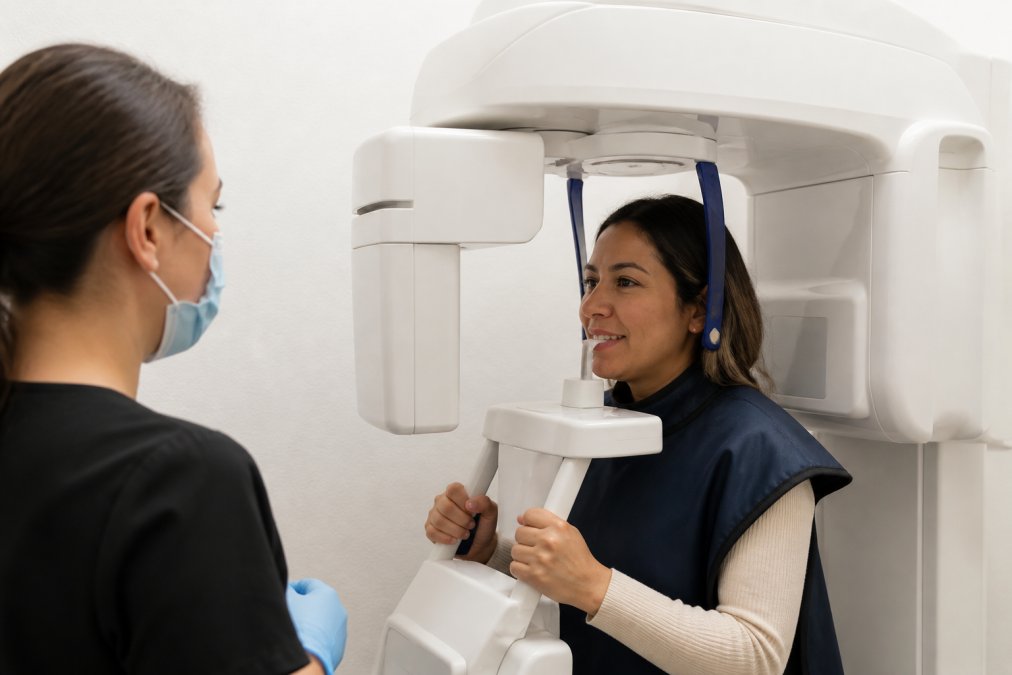
Bone height and width thresholds determine if you need a graft. Most implants require specific height and width dimensions. If your measurements fall below these thresholds, a graft is necessary. Your dentist will share your specific measurements.
Bone density matters as much as volume. CBCT scans measure bone quality on a Hounsfield scale. Dense bone (Type I or II) provides better stability and faster osseointegration, while softer bone (Type III or IV) may need longer healing or additional grafting.
Traditional 2D X-rays have serious limitations for implant planning. They show bone loss but cannot measure precise dimensions, assess density, or avoid distortion and overlap. CBCT is the standard of care because it confirms exact bone volume.
Physical examination confirms what imaging reveals. Your dentist palpates your jaw to sense ridge anatomy and thickness. Severe bone loss is obvious to touch, complementing imaging data.
Your dentist measures bone dimensions in multiple locations. Bone volume varies across your jaw. Site-by-site measurement determines whether you need a full-arch graft, localized grafts, or no graft.
At Osuna Dental Care in Albuquerque, we use advanced 3D imaging to show you exactly what you need. We serve Rio Rancho, Placitas, North Valley, Uptown, and Nor Este with expert precision and care.
Dental Implant Bone Graft Recovery Time and Healing
Recovery from a bone graft takes time, but understanding the timeline and the type of graft material used helps you prepare realistically.
The type of graft material affects your healing timeline. Not all bone grafts are the same. Your dentist may use one of three main types, each with different healing characteristics:
-
Autografts (your own bone): Bone harvested from another part of your jaw or body. This is the "gold standard" because your body recognizes it as your own bone. Autografts heal fastest, typically integrating in 3-4 months. The trade-off is a second surgical site (donor area) that also needs healing. Recovery is slightly longer because of the additional surgery.
-
Allografts (donor bone from a cadaver): Processed bone from a human donor, screened for safety and disease. Allografts eliminate the need for a second surgical site, reducing overall surgery time and discomfort. However, they integrate slightly slower than autografts, typically 4-6 months, because your body must gradually replace the donor material with your own bone.
-
Synthetic grafts (lab-made materials): Bone substitutes made from ceramics, polymers, or other biocompatible materials. These are predictable, readily available, and require no donor site. Integration timelines vary by material, typically 4-6 months. Some synthetic materials are designed to dissolve as your body replaces them with new bone; others remain as a permanent scaffold.
Your dentist will recommend the best material for your situation based on the size of the graft, your healing capacity, and your preferences.
Initial healing takes 1-2 weeks. Swelling and discomfort peak in the first 2-3 days, then improve. Most people return to light activities after one week. Sutures are removed at 10-14 days.
Full bone integration takes 3-6 months. During this critical phase, protect the graft site by avoiding hard foods, strenuous exercise, heavy lifting, smoking, and alcohol.
Post-graft dietary guidelines for the first 72 hours. Eat soft, cool foods like yogurt, applesauce, mashed potatoes, and cooled soup.
| Recovery Phase | Timeline | What to Expect | Material Impact |
|---|---|---|---|
| Immediate post-op | 0-3 days | Swelling, discomfort, bleeding | All materials similar |
| Initial healing | 1-2 weeks | Sutures removed, swelling decreases | All materials similar |
| Early integration | 2-6 weeks | Pain fades, site looks normal | Autografts may heal slightly faster |
| Bone formation | 6 weeks-3 months | Graft material incorporates | Autografts typically fastest; synthetics vary by type |
| Full maturation | 3-6 months | New bone is strong enough for implants | Allografts and synthetics may need full 6 months |
Scheduling Your Dental Implant Consultation in Albuquerque
The first step is a consultation with an experienced implant dentist. This appointment determines your exact needs and creates your treatment plan.
Frequently Asked Questions
How do I know if I have enough bone for dental implants?
Your dentist uses 3D imaging (CBCT scans) to measure your jawbone density and volume. If your alveolar bone height or width falls below what's needed for implant stability, a bone graft becomes necessary. During a consultation, imaging reveals whether your bone can support implants directly or if grafting is required first.
What happens if you don't get a bone graft when needed?
Skipping a necessary bone graft risks implant failure. Without adequate bone volume, dental implants lack the foundation for osseointegration, the process where bone fuses with the implant. Failed implants can shift, loosen, or fail to integrate, requiring extraction and additional treatment. Addressing bone deficiency upfront ensures long-term implant success and stability.
How long does a bone graft take to heal before an implant?
Bone graft healing takes several months, depending on graft type and your body's healing response. During this time, the graft material integrates with your natural bone, rebuilding adequate volume and density. Your dentist monitors healing with imaging and places the implant once bone regeneration is complete and sufficient for implant stability.
What are the signs of bone loss in the jaw?
Signs of jawbone loss include a sunken facial appearance, changes in bite alignment, loose teeth, gum recession, and difficulty wearing dentures. Bone resorption often happens silently without pain, so regular dental visits catch it early. If you've had tooth extraction, gum disease, or trauma, ask your dentist to assess your bone density during your next appointment.
